South Boston's condo median rose 24.6% year over year in September 2026, to $885,000. In the same month, sellers received 94.6% of their original list price, down from 97.1% in September 2025. The higher median gets the attention, but the drop in list-price ratio is where a buyer can negotiate this fall. Neither number has anything to do with the thousands of homes now proposed along Dorchester Avenue. That pipeline matters for South Boston's future, but it hasn't reached current prices, and the reason comes down to construction cost.
The September jump rests on 23 sales
The Massachusetts Association of Realtors' September 2026 South Boston report counts 23 closed condo sales for the month. The August report counts 30. With samples this small, a few large units closing in one month can swing the median, and MAR says so in a footnote on each sheet: "Activity for one month can sometimes look extreme due to small sample size."
| South Boston condos | August 2026 | September 2026 | Year to date through September |
|---|---|---|---|
| Closed sales | 30, down 31.8% | 23, up 9.5% | 258, down 14.0% |
| Median sale price | $799,500, down 14.7% | $885,000, up 24.6% | $877,500, up 0.3% |
| Cumulative days on market | 54 | 60 | 50 |
| Share of original list price received | 97.6% | 94.6% | 97.2% |
The median fell 14.7% in August and rose 24.6% in September. Over nine months, it moved three-tenths of one percent. Volume changed more. South Boston recorded 258 condo closings through September 2026, compared with 300 in the same period of 2025. Prices have held steady while fewer deals close, which is how a market behaves when buyers and sellers disagree on value and transactions slow down.
Where the fall listings went
In August 2026, 15 condos came onto the South Boston market. In September, 74 did. Inventory went from 75 units at the end of August to 120 at the end of September. That looks like a lot of supply, but September 2025 ended with 125 condos for sale, so this is the usual fall listing wave and not an unusual glut.
A buyer feels the difference in how long homes sit and how much sellers give up. Cumulative days on market reached 60 in September 2026, up from 54 a year earlier, and pending sales dropped to 14 from 17. Months of supply was 4.4. Boston as a whole was looser, with 5.5 months of supply, 63 days on market, and a $777,500 median on 242 condo sales in September 2026, according to MAR's citywide report. South Boston is tighter than the city overall and still costs more per sale. The new homes on Dorchester Avenue account for none of that, because none of them exist yet.
A decade of approvals, and far fewer buildings
The city adopted PLAN: South Boston Dorchester Avenue in 2016. It covered the industrial stretch between the Broadway and Andrew Red Line stations and envisioned up to 16 million square feet of new development. A Boston Globe analysis found that the city approved 6.7 million square feet of projects in the corridor from 2016 through 2024. Nearly a dozen housing projects were built, and several approved developments are still unbuilt after several years of real estate market turbulence. The plan's guidelines were also never written into Boston's zoning code, so tall projects still need separate approval to reach the heights the plan described.
Here is where the corridor's best-known projects stand, based on public records:
- Washington Village, 235 Old Colony Ave. Samuels & Associates' first phase, the 214-unit South Standard, is open. The full plan calls for 746 homes and more than 82,000 square feet of retail. City records show a partial certificate of completion dated October 1, 2025. We couldn't confirm the status of the remaining phases.
- On the Dot, near Andrew Square. In 2024 the city approved Core Investments' phase with a 16-story, 237-unit market-rate building and a seven-story, 94-unit senior building. In April 2025, Boston Real Estate Times still described the residential groundbreaking as "expected in 2025." We found no public source confirming that construction started.
- 323-365 Dorchester Ave. National Development's four-building plan, with 310 homes and 623,000 square feet of office and lab space, won approval in December 2021. The newest entries on the city's project timeline date from 2022, and we found no current construction status.
That gives one delivered building, two approvals with unconfirmed status, and a decade gone. The newest proposal is the largest of them.
The block where Dorchester and Old Colony split
The parcels at 314-420 Dorchester Ave. sit midway between the Broadway and Andrew stations, at the center of the 2016 plan. For years they were assembled and pitched to investors as a life-science campus. According to the Globe, no project was ever formally filed with the city. The site sold at a foreclosure auction on St. Patrick's Day 2026, held in the triangular parking lot of the vacant Castle Self Storage, with an affiliate of New York's J.T. Magen & Co. winning at $75 million.
In September, J.T. Magen, Extell Development, and local partner Tom O'Brien of The HYM Investment Group started city review. Their plan calls for 1,945 homes in four buildings no taller than 200 feet, or roughly 18 stories each, plus about 45,000 square feet of ground-floor retail, and the team is exploring a grocery store, the Boston Globe reported. The team hopes to have all permits by early 2027. The drive-through Dunkin' at 75 Old Colony Ave. is set to "stay for as long as possible." Caught in Southie described the filing as one of the largest new housing proposals in Boston in years.
O'Brien explained the team's reasoning to the Globe:
"The idea is to build as fast as possible. Not much housing is being built right now. ... You'd be delivering those units into a market that has not had much new product, and that's a really important consideration."
The arithmetic that keeps cranes away
The same Globe article puts the cost of new high-rise residential construction in Boston at more than $1 million per unit, and underground parking at about $350,000 per space. South Boston's year-to-date condo median through September 2026 is $877,500.
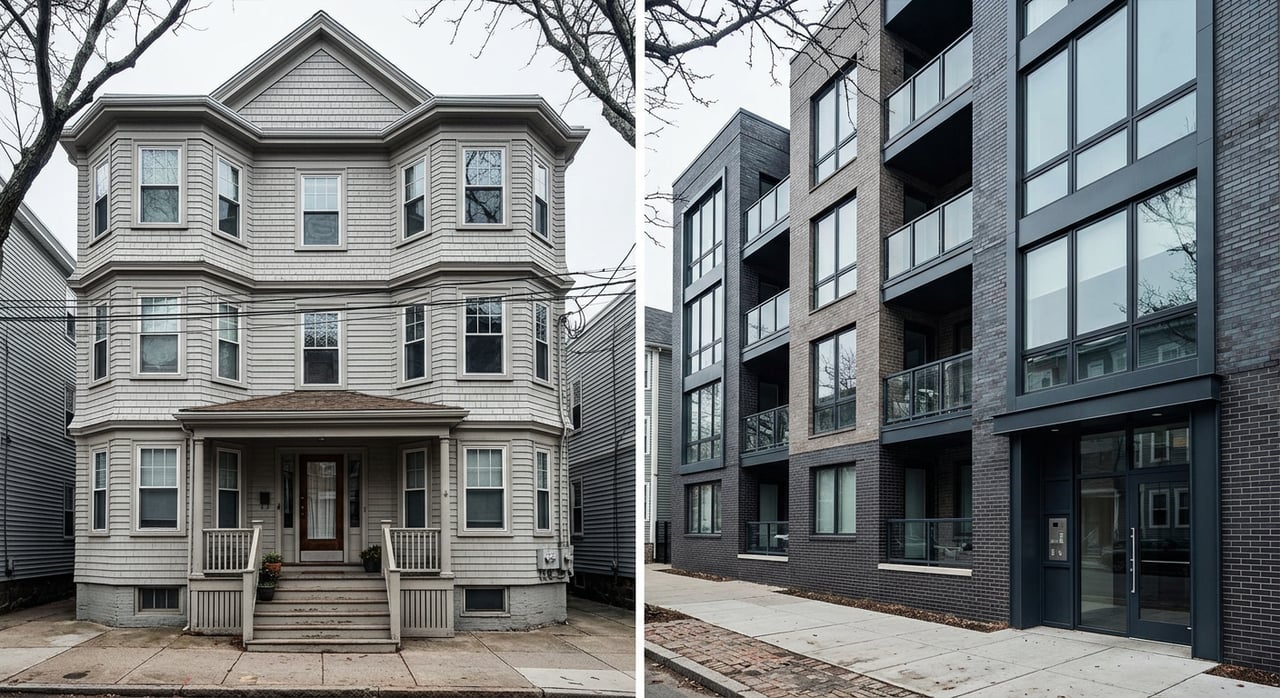
At the median, an existing South Boston condo sells for less than it would cost to build a new high-rise unit, before counting a parking space. This is why the pipeline and current prices stay separate. A new tower only makes financial sense if its units sell or rent at prices that cover construction, which puts them at or above the top of today's resale market. A two-bedroom in a converted triple-decker on East Fourth Street competes with other resale units for the same buyers. It doesn't compete with a building that still needs zoning approval and has to clear $1 million a unit before it pencils out.
This cost gap also explains the stalled approvals. When existing homes trade below replacement cost, developers have little reason to start digging, and an approval can sit for years. The use of the corridor's largest site has also changed. The earlier pitch for 314-420 was a life-science campus, and the new filing is housing. Public reporting documents that change without assigning it a single cause.
The dates that matter between now and spring
On the waterfront side, Gillette is pursuing a master plan for its 31-acre South Boston campus. The concept includes about 1,800 homes, a 6.5-acre waterfront park, and office, research, retail, and hotel space, and it remains under city review. This summer, Gillette's parent company P&G paid $99.3 million for the 2.4-acre 232 A Street site, which has a previously approved 324,000-square-foot office and lab project, Caught in Southie reported.
A related zoning change is moving through City Hall now. A proposed amendment to Article 68 and Map 4F would let Planned Development Areas be proposed in the Waterfront Manufacturing subdistrict and would shift its boundary with the First Street Local Industrial subdistrict. The city's own presentation says the amendment does not create or approve any PDA, and that any project would still go through Article 80 community review. Public comment closed October 7. The BPDA Board meets October 15, and the Zoning Commission is scheduled for November 2026.
Two infrastructure projects are on similar timelines. The city's Andrew Square Safety Project is in design and lists 2029 as its expected completion year. The MBTA's plan for new elevators and a West Fourth Street headhouse at Broadway station is listed as paused pending construction funding, according to the project page, which reports design status as of February 2025.
A few questions buyers ask
Should South Boston buyers expect prices to drop when the new towers arrive?
None of the proposed towers has a building permit yet. The 314-420 team is aiming for permits in early 2027, and approvals in this corridor have historically taken years to turn into buildings. Given current construction costs, any new units would likely be priced at or above today's resale range.
Which number tells you more this fall, the median or the list-price ratio?
For negotiating, the list-price ratio. In September 2026, South Boston condo sellers received 94.6% of original list price, compared with 97.1% a year earlier, and cumulative days on market reached 60.
Does the October 15 BPDA Board meeting approve Gillette's housing?
No. The city's presentation says the amendment only allows Planned Development Areas to be proposed in the Waterfront Manufacturing subdistrict. Any project would still go through its own Article 80 review.
If you're weighing a South Boston condo against what the Dorchester Avenue pipeline might bring, The Morgan Franklin Group can go through the building-level details with you: the sale history, list-price trends, and which nearby approvals have actually broken ground. Book a personalized market consultation, and we'll start with the units on your shortlist.